
Agrotextile Demonstration Centre
The Climate Smart Agrotextile Demonstration Centre
The Climate Smart Agrotextile Demonstration Centre, established by SASMIRA under the National Technical Textiles Mission (NTTM) at Navsari Agricultural University, Gujarat, is a pioneering initiative aimed at advancing Indian agriculture through the integration of advanced agrotextile technologies and digitized microclimate farming. It was inaugurated on 21st December 2024 by Shri C.R. Patil, Hon’ble Minister of Jal Shakti, Government of India in the esteemed presence of Shri Raghavjibhai Hansrajbhai Patel, Hon’ble Cabinet Minister of Agriculture, Animal Husbandry, Government of Gujarat.
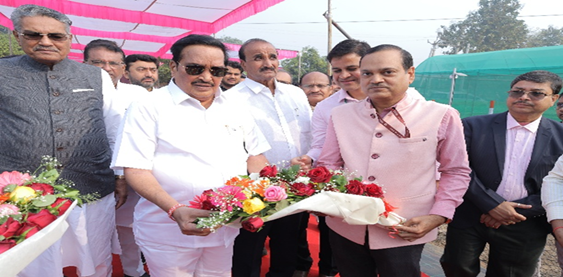
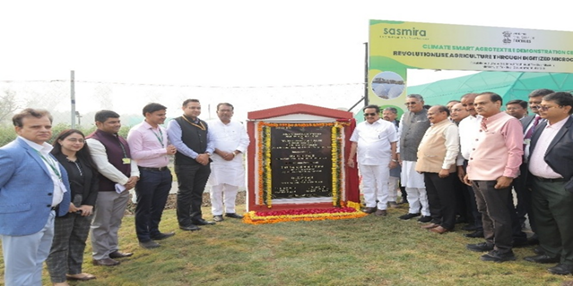
Inauguration of the Climate Smart Agrotextile Demonstration Centre by Shri C.R. Patil, Hon’ble Minister of Jal Shakti, Government of India, in the esteemed presence of Shri Raghavjibhai Hansrajbhai Patel, Hon’ble Cabinet Minister of Agriculture, Animal Husbandry, Government of Gujarat
Since its inauguration, the centre has achieved significant progress across all key objectives, emerging as a nationally recognized hub for demonstration, training, research and capacity building in climate-resilient agriculture. The centre has undertaken systematic, side-by-side comparative demonstrations of advanced agrotextile applications, including PAR perfect and photoselective shade nets, non-woven crop covers, woven and jute ground covers, vertical farming systems, medicinal nurseries, vermicomposting beds, and pond liners. These demonstrations have generated strong empirical evidence, with notable yield improvements such as 18.33 % in cherry tomato under shade nets, 97.22 % in capsicum under photoselective nets, 140.82 % in lettuce grown through vertical farming, and up to 151.59 % in coloured cauliflower under woven ground covers.
An integrated IoT-based environmental monitoring system has further strengthened the centre’s outcomes by providing real-time data on key parameters such as temperature, humidity, solar radiation, UV exposure, wind speed, and soil conditions. This has enabled clear validation of the role of agrotextiles in creating optimized microclimates for enhanced crop productivity
Objectives of the Climate Smart Agrotextile Demonstration Centre
The key objectives of the Climate Smart Agrotextile Demonstration Centre are:
- Demonstration of Agrotextile Applications – Provide real-time, field-based demonstrations of a wide range of agrotextile products such as shade nets, crop covers, ground covers, mulch mats, vermibeds, and pond liners.
- Promotion of Climate-Resilient Farming – Introduce digitized microclimate monitoring systems to help farmers understand the influence of temperature, humidity, soil moisture, and light on crop performance.
- Capacity Building for Farmers and Stakeholders – Organize training programs, field visits, workshops, and interactive sessions to disseminate best practices in the use of agrotextiles.
- Development of an Agrotextile Database – Systematically collect, analyse, and document data on microclimatic parameters, crop yields, and soil health to support research and policy development.
- Encouragement of Research and Innovation – Collaborate with agricultural universities, research institutions, and industry partners to develop new applications and improve existing agrotextile technologies.
Enhancing Awareness and Adoption – Engage with industry leaders, policymakers, and extension agencies to promote wider acceptance and scaling of agrotextile solutions in agriculture.
Demonstration and Training Activities
Since its establishment, the Climate Smart Agrotextile Demonstration Centre has:
- Hosted farmers from different regions who visited the centre to gain hands-on experience with agrotextile applications.
- Conducted technical training sessions covering shade net farming, crop covers for pest control, ground covers for weed management, irrigation techniques using pond liners, and vermibed composting.
- Developed a practical demonstration zone for farmers to observe how agrotextile materials affect crop growth, water conservation, and soil fertility.
- Launched a mobile training initiative, where experts from SASMIRA and NAU visit nearby agricultural communities to educate farmers on agrotextile solutions.
Training and Capacity Building Activities
The Climate Smart Agrotextile Demonstration Centre has emerged as a premier knowledge hub for agricultural innovation, serving a diverse spectrum of stakeholders through structured training and capacity building programs. Since its inauguration, the centre has conducted regular training sessions, hands-on demonstrations, field visits, and interactive workshops tailored to meet the specific needs of different audience segments. These programs are designed to bridge the gap between theoretical knowledge and practical application, ensuring that participants gain not only an understanding of agrotextile technologies but also the confidence and skills to implement them on their own farms or within their enterprises. The training curriculum encompasses a wide range of topics, including selection and installation of shade nets, crop covers, and ground covers; irrigation management using pond liners; vermicomposting techniques using HDPE vermibeds; integrated nutrient management; and the use of IoT-based monitoring systems for precision agriculture. Each session combines instruction with live demonstrations in the research plots, allowing participants to observe the real-time performance of different agrotextile products and ask questions directly to the experts from SASMIRA and Navsari Agricultural University.
Outreach and Participant Demographics
Since inception the centre has successfully trained a total of 1,378 visitors, reflecting the growing recognition of agrotextiles as a transformative input for modern agriculture. Among these participants, 815 were farmers—the primary target group for technology adoption and the ultimate beneficiaries of the centre’s outreach efforts. The remaining participants include agricultural college students, school students, industry professionals such as agrotextile manufacturers and structure installation service providers, government officials, and extension officers. The geographical reach of the training programs has been particularly noteworthy, with farmers traveling from across India to gain first-hand knowledge of the demonstration centre’s innovations. Participants have come from Gujarat (the host state), as well as from Madhya Pradesh, Uttar Pradesh, and Meghalaya, representing a diverse cross-section of India’s agricultural landscapes. This pan-Indian participation underscores the centre’s reputation as a nationally significant facility and highlights the widespread interest in climate-smart agricultural technologies. The presence of farmers from such geographically and climatically diverse regions also enriches the learning environment, enabling cross-sharing of experiences and adaptation strategies from different farming systems.
Student Engagement and Industry Collaboration
Recognizing the importance of nurturing the next generation of agricultural professionals, the centre has placed special emphasis on engaging students from agricultural colleges, polytechnics, and schools. Student visits have provided young learners with invaluable exposure to cutting-edge agricultural technologies, inspiring them to consider careers in modern, technology-driven farming and agribusiness. These educational visits are designed to be interactive and experiential, allowing students to participate in data collection activities, observe IoT monitoring systems in action, and understand the scientific principles underlying agrotextile applications. In parallel, the centre has actively engaged with industry stakeholders, including agrotextile manufacturers, structure installation and erection service providers, and government officials from agriculture and textile departments. These industry collaborations serve multiple purposes: they help manufacturers understand farmer needs and product performance in real-world conditions; they enable service providers to refine their installation techniques; and they assist government officials in developing informed policies and extension programs to support agrotextile adoption. By creating a dynamic platform that connects farmers, students, industry, and policymakers, the centre is building a robust ecosystem for agrotextile innovation and scaling, ensuring that the benefits of these technologies reach farming communities across the nation.
Training Sessions at Demonstration Centre
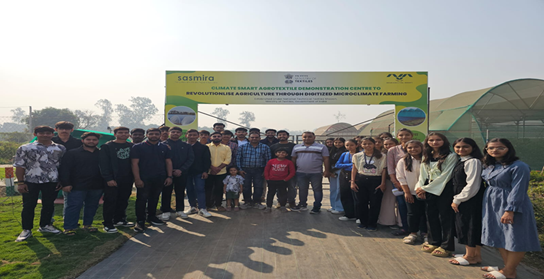
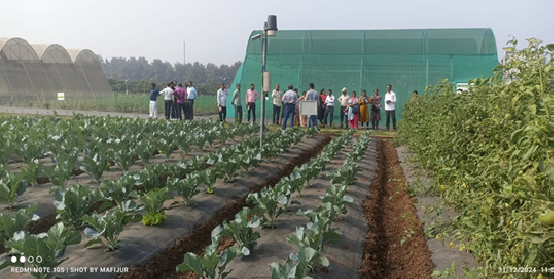
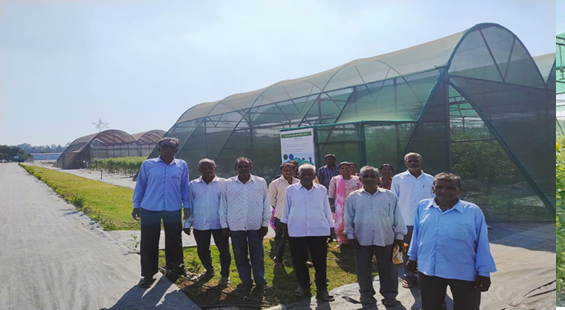
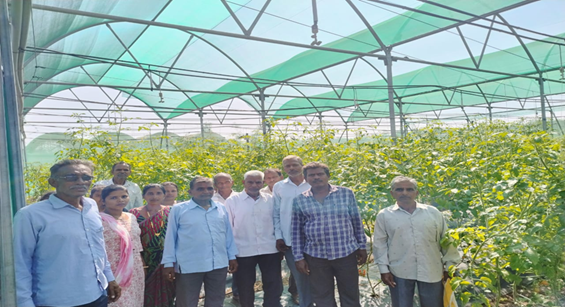
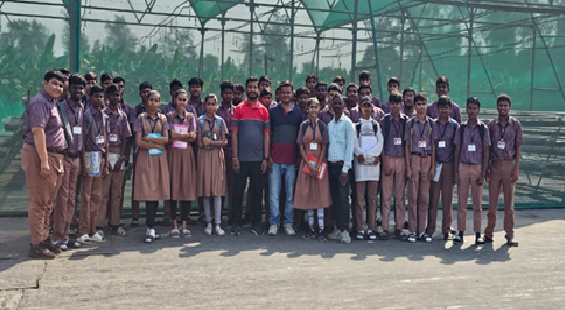
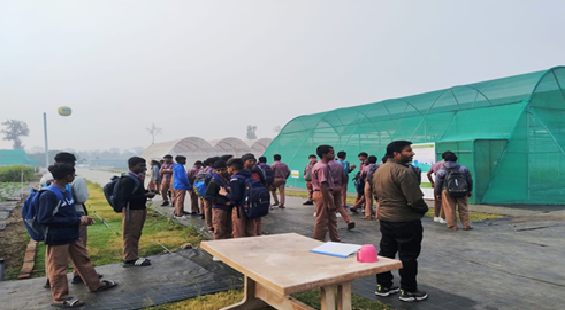
A group of 40 students from Ambica High School, Gadat, Navsari visited the demonstration centre, where they were introduced to various agrotextile products and their practical applications
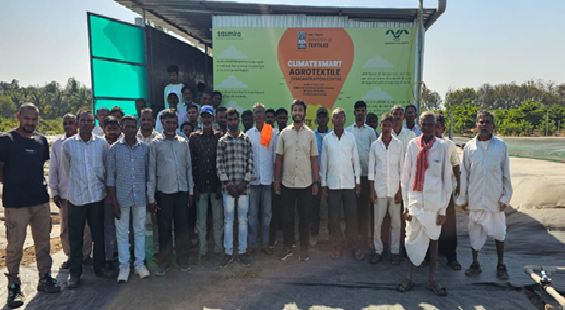
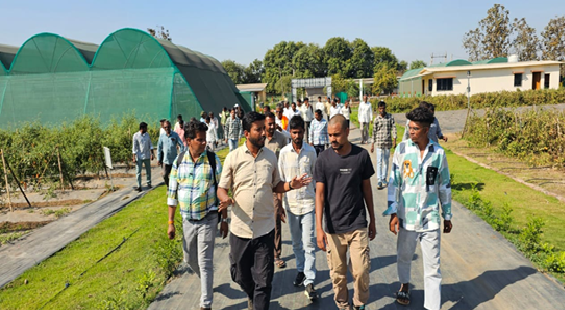
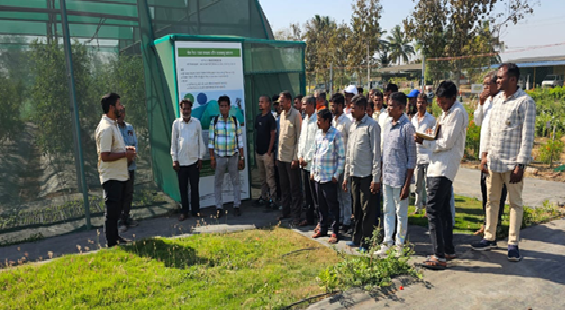
Mr. Bamdev Tripathi, an officer from the Aga Khan Foundation in Narmada District, Gujarat, along with 54 farmers from the region, visited the demonstration centre. They found the centre to be highly informative and innovative, particularly in its application of agrotextiles and protected cultivation farming using smart climate control devices.